
Intertangle
Entanglement-based quantum connectivity
Securing communications, empowering quantum devices
What We Do
Intertangle is building quantum networking and communications systems, applying breakthrough technology to existing infrastructure.
We’re developing a readily customisable photonic platform for generating, distributing, and measuring entanglement, the resource that lets quantum devices connect reliably to each other over deployed infrastructure. This is delivered as a system, integrating entanglement sources, entanglement measurement modules, the control software that runs them, and the logging that keeps a record of every outcome.
Our Technology
At the core of our platform is a multi-mode approach to entanglement: generating and measuring entangled photons across multiple properties of light within the same fibre, rather than a single channel. It’s a similar principle to how classical networks multiplex channels to increase capacity, and it gives our systems better noise resistance and higher information capacity than conventional single-mode approaches. The platform’s architecture is also designed to be flexible enough to support multipartite entanglement, distributed to more than two parties at once, for larger multi-user networks.
What We Offer
Robust operation
Our systems are benchmarked against industry-leading standards for entanglement quality and generation rate. That performance is engineered to hold steady beyond the lab bench, not just as a one-off result under ideal conditions.
Trust and Control
We’re developing simple-to-operate tools for characterising and certifying the quantum properties of light, so measurement doesn’t require a specialist.
Delivered as Entanglement-as-a-Service, hardware paired with automated, customisable control software, so you’re not left integrating a black box on your own.
Increased Functionality
Our platform is multimodal by design. Harnessing multiple properties of light, polarisation and spatial structure, lets us provide quantum light sources that adjust to your needs, with better tolerance to noise and loss than single-mode approaches. That same flexibility carries through the architecture, letting it scale from a single link to multi-nodal networks as your requirements grow.
Easy Integration
Our systems are built for drop-in compatibility with deployed infrastructure, fibre or free-space, operating at 810 nm or 1550 nm depending on the application. The same design adapts across network scales, from short-distance links to long-distance deployment, without needing new infrastructure built around it.
Validated in the Field
In 2025, we ran the first real-world test of our entanglement platform at BT’s Adastral Park research park.
Using both the polarisation and the spatial structure of light, our benchtop system demonstrated multimodal entanglement distribution outside the lab — a proof-of-principle step toward robust and high-capacity quantum connectivity.
BT named it among its “major strides” in UK quantum readiness for 2025, “validating how entanglement can support new forms of secure communication and information processing”.
Benchtop Multimodal Entanglement System
Polarisation + spatial entanglement, generated, distributed, and certified using off-the-shelf components over commercial fibre. Operating at 810 nm for high-efficiency APD-based detection and readily adaptable to the telecom band, the system was validated for intra-data-centre-scale performance.
Our account of the trial:
“From Curiosity to Capability: Taking Quantum Beyond the Lab”
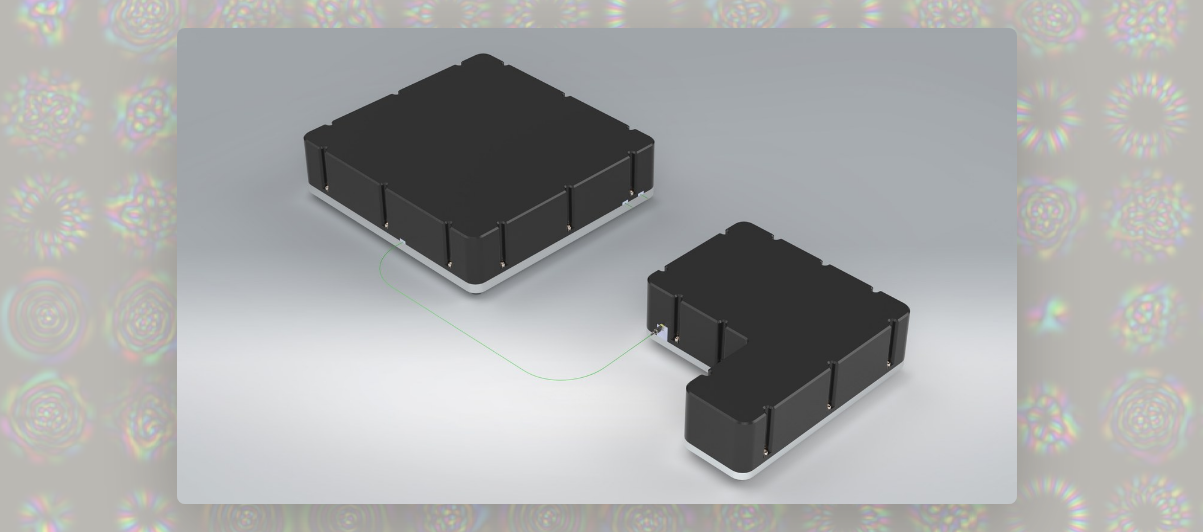
We’re proud to partner with Intertangle to advance entanglement-based quantum technology
What’s Next
Download our technical brochure
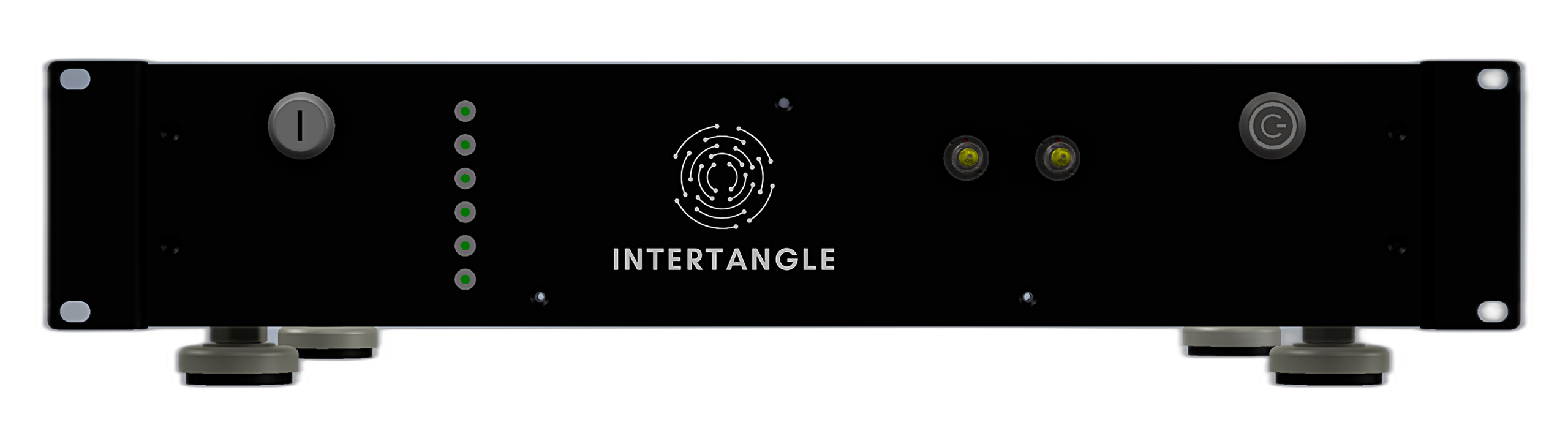
Our current prototype delivers leading performance in an architecture built toward multi-node and multi-modal quantum networks. It pairs a high-fidelity polarisation entanglement source with receiver modules and control software in one 19-inch rack-mount unit, built for long-distance deployment over standard telecom fibre.
Ready for external trials in October 2026!
Intertangle Team
We are a team from the Institute of Photonics and Quantum Sciences at Heriot-Watt University, Scotland. We are experts in creating advanced quantum light sources and entanglement-based tools to enable practical quantum technologies.

Dr Natalia Herrera Valencia
Project Lead

Dr Joseph Ho
Technical Lead

Prof. Mehul Malik
Scientific advisor

Prof. Alessandro Fedrizzi
Scientific advisor

Anne Johnson
Commercial advisor
Where can Intertangle be used?
Research & Development
State-of-the-art equipment for testbeds and quantum information protocol demonstrations, with a modular, readily customisable architecture. Built to help you explore potential use cases and scope new services and products.
Academic Research & Teaching
Reliable and compact entanglement-based tools that can be easily integrated and adapted into cutting-edge academic research and teaching modalities
Telecommunications
Entanglement distribution for next-generation quantum communication systems, with the noise and loss tolerance to run over deployed telecom infrastructure. No specialist team required to run them.
Quantum Networking Industry
Entanglement links to support future interconnected quantum devices, extending sensing capabilities and allowing for distributed computing.
Finance
Entanglement gives two parties shared randomness they can turn into cryptographic material, helping secure financial transactions and support reputational risk management.
Defence
Highly secure communication channels for military and government agencies, plus entanglement-based sensing for precision timing and navigation.
Energy & Utilities
Entanglement is inherently sensitive to interference: any attempt to tap or tamper with the link leaves a detectable trace, adding a layer of security cyber-only tools can’t reach. Entanglement-based sensing could also support precision timing for synchronising distributed infrastructure.
We would love to speak to you!
If you are developing quantum technologies, are looking at integrating quantum systems to boost the performance of your current applications, or want to learn more about our entanglement platform, please get in touch!
.
Contact Us
Have a query?
Interested in what Intertangle could do for you? Please get in touch!
Email:
naherrerav@intertangle.co.uk
Address
Institute of Photonics and Quantum Sciences
Herriot-Watt University
EH14 4AS, Edinburgh, UK